Email Us
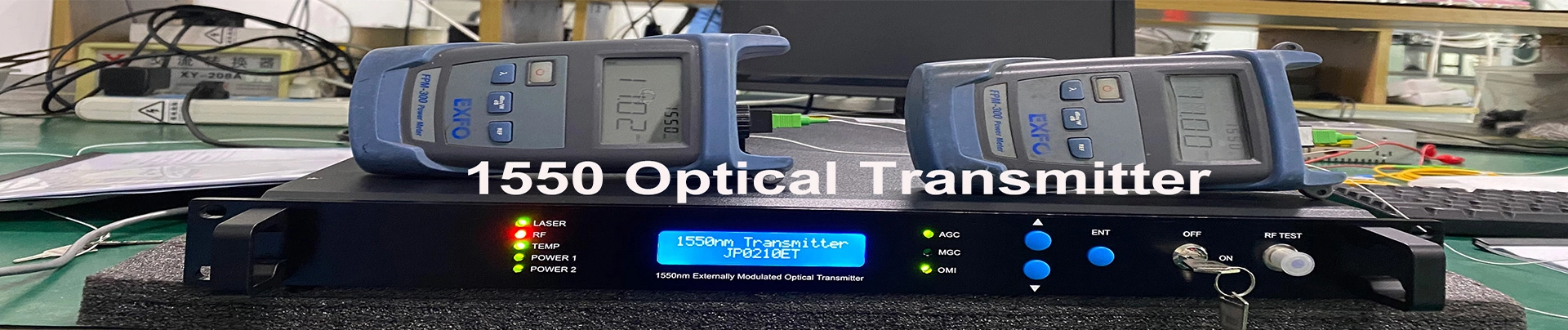
1550 Optical Transmitter

1550 Optical Transmitter

Contact us

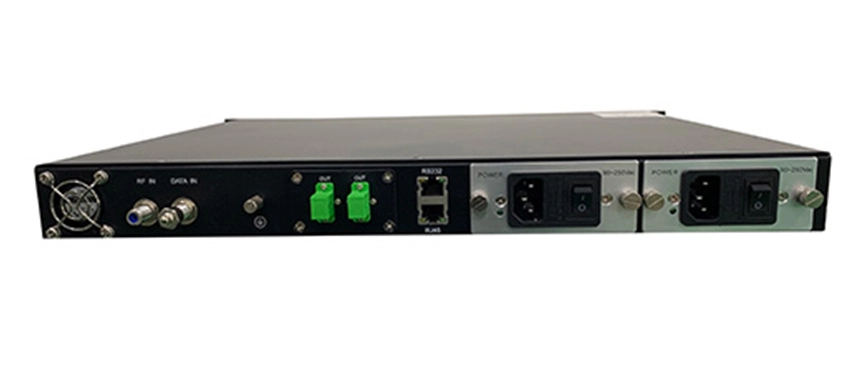
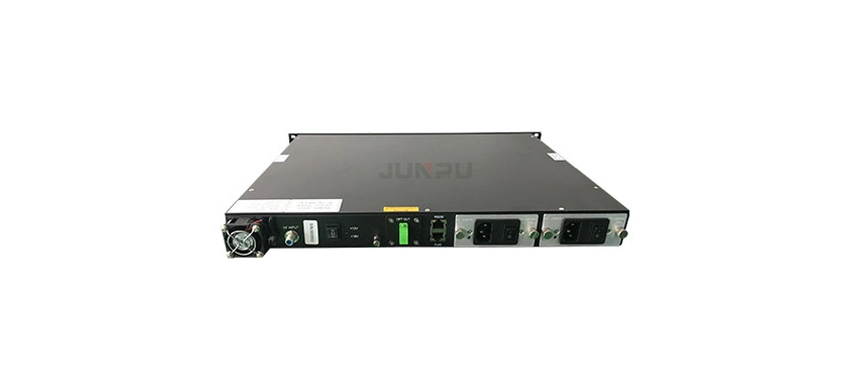
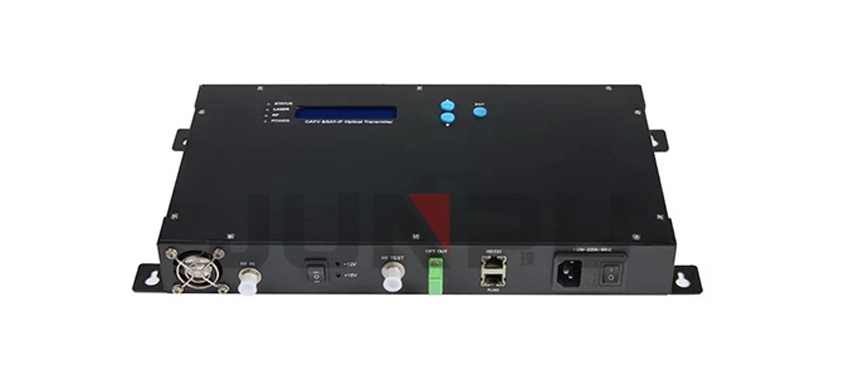
The 1550 Optical Transmitter is a device that converts electrical signals into optical signals, allowing for long-distance transmission of data. It is commonly used in telecommunications networks and fiber optic communication systems. The 1550 transmitter operates at a wavelength of 1550 nm, enabling high-speed and reliable data transmission over fiber optic cables.

Types of JUNPU 1550 Optical Transmitter

JUNPU 1550nm Optical Transmitter Models and Types

Model TypeModulation TypeOutput Power OptionsDistance (Typical)Key FeaturesBest For
Internal Modulated CATV TransmitterDirect (DML)+6~+10dBmUp to 30kmCost-effective, AGC/MGC, low chirpShort-medium haul CATV
1550nm Directly Modulated TransmitterDirect (DML)+7~+11dBm20-30kmSupports DOCSIS 3.1, 1.2GHz bandwidthFTTH/CATV upgrades
External Modulated CATV TransmitterExternal (EML)2x7~2x13dBm (dual port)50-100+km w/ EDFANo chirp, high SBS threshold (+19dBm), excellent CNR/CSO/CTBLong-haul trunk, DWDM
Wall Mountable CATV SAT TransmitterDirect/External+8~+10dBm20-50kmCompact wall-mount, SAT-IF + CATVResidential/ hotel installs


Direct Modulated (DML) vs. Externally Modulated (EML): How to Choose?

Choose DML (Internal Modulated) if your project is a short-to-medium haul (≤30km) CATV or FTTH upgrade. It is highly cost-effective and features AGC/MGC for stable signal control.


Choose EML (External Modulated) for long-haul trunk lines (50km-100km+) or DWDM systems. It eliminates "laser chirp," provides a higher SBS threshold (+19dBm), and delivers superior CNR/CSO/CTB performance when combined with EDFA (Erbium-Doped Fiber Amplifiers).


1550nm vs. 1310nm: Why 1550nm is the Standard for Modern CATV Networks?

Choosing the right wavelength is critical for optical network efficiency. While 1310nm is common for short-distance data transmission, the 1550nm optical transmitter is the preferred choice for HFC (Hybrid Fiber-Coaxial) and long-haul CATV networks for two primary reasons:


Ultra-Low Signal Attenuation:

In quartz fiber, the 1550nm wavelength hits the "minimum loss window." It has the lowest attenuation rate (approximately 0.2dB/km), compared to 0.35dB/km for 1310nm. This allows signals to travel significantly further without degradation, making 1550nm the only viable choice for long-distance trunk lines and city-wide broadcasting.


High-Gain Amplification with EDFA:

The game-changing advantage of 1550nm is its compatibility with EDFA (Erbium-Doped Fiber Amplifiers). Unlike 1310nm signals, which require costly optical-electrical-optical conversion to refresh, 1550nm signals can be boosted directly in the optical domain. This capability allows a single 1550nm transmitter to be amplified and split to serve thousands of end-subscribers across an entire metropolitan area, drastically reducing the cost per user.


DWDM Integration:

The 1550nm band (C-band) is the foundation for DWDM (Dense Wavelength Division Multiplexing) technology. Using a JUNPU 1550nm transmitter allows you to expand your network capacity in the future by multiplexing multiple signals over a single fiber strand.


Key Features of a 1550 Optical Transmitter

High-speed data transmission:

A key feature of a 1550 Optical Transmitter is its ability to transmit data at high speeds. By converting electrical signals into optical signals, it enables fast and efficient data transmission over fiber optic cable.


Long-distance capabilities:

The 1550 Optical Transmitter is designed to support long-range transmission of data. It can send optical signals over significantly long distances, ranging from several kilometers to hundreds of kilometers, without the need for signal repeaters.


Wavelength stability:

The transmitter 1550 operates at a specific wavelength of 1550 nm, ensuring reliable and stable transmission of data. The wavelength stability feature guarantees that the optical signals maintain their integrity and do not suffer from signal degradation or interference.


Compatibility with various fiber optic communication systems:

The 1550 Optical Transmitter is compatible with different types of fiber optic communication systems, making it a versatile device. It can seamlessly integrate into telecommunications networks, cable TV systems, internet services, and other applications.


Low signal loss and resistance to interference:

The 1550 Optical Transmitter is an optical communication equipment designed to minimize signal loss during data transmission. It employs advanced technologies that reduce signal degradation, ensuring high-quality data transmission. Additionally, the optical transmitter 1550nm is designed to resist interference, ensuring reliable and clear communication without disruptions or noise.


If you are interested in the 1550nm optical transmitter price, please leave us your message.

FAQs of 1550 Optical Transmitter

How can I get the 1550nm optical transmitter price and datasheet?

As a direct manufacturer, JUNPU offers competitive factory pricing. You can click the "Get a Quote" button or email us at info@junpu-catv.com. Our technical team will provide a detailed price list and PDF datasheets based on your specific power output (+7dBm to +13dBm) and distance requirements.

What is a 1550 Optical Transmitter?

A 1550 Optical Transmitter is a device utilized in fiber optic communication systems that converts electrical signals into optical signals at a wavelength of 1550 nm.


What is the purpose of a 1550 Optical Transmitter?

The main purpose of a 1550 Optical Transmitter is to enable long-distance transmission of data over fiber optic cables by converting electrical signals into optical signals.

How does a 1550 Optical Transmitter work?

The 1550 Optical Transmitter uses an electrical input signal and converts it into an optical signal through a process called modulation. The optical signal is then transmitted over a fiber optic cable.

What are the advantages of using a 1550 Optical Transmitter?

The advantages of using a 1550 Optical Transmitter include low signal loss, high data capacity, resistance to interference, and the ability to transmit data over long distances without the need for repeaters.

Are there any maintenance requirements for a 1550 Optical Transmitter?

Routine maintenance for a 1550 Optical Transmitter includes monitoring the power levels and wavelength stability, checking for any loose connections, and keeping the device clean from dust and debris.

What's the difference between a 1550nm Directly Modulated (DML) and Externally Modulated (EML) Transmitter, and which one should I choose for my project?

This is a crucial choice that depends on your distance, budget, and performance requirements:

1550nm Directly Modulated Laser (DML) Transmitter:

How it works: The RF signal directly modulates the laser diode's current.

Best for: Cost-sensitive applications, CATV distribution networks, RFoG systems, and distances up to ~30-40 km.

Pros: Lower 1550nm optical transmitter price, simpler design, smaller footprint.

Cons: Higher chirp, which can limit transmission distance and performance in dense, long-haul DWDM systems.

1550nm Externally Modulated Laser (EML) Transmitter:

How it works: A continuous-wave (CW) laser feeds an external LiNbO₃ (Lithium Niobate) modulator, which is then modulated by the RF signal.

Best for: Long-haul telecom backbone (>80 km), DWDM/CWDM systems, applications requiring the highest CNR/CSO/CTB performance, and where very low chirp is essential.

Pros: Superior linearity, ultra-low chirp, enables much longer transmission distances.

Cons: Higher initial cost, larger size.

Simple Choice Guide:

Choose DML for standard CATV distribution and shorter links where budget is key.

Choose EML for maximum distance, backbone networks, or advanced multi-wavelength systems.


Are JUNPU's 1550nm optical transmitters compatible with our existing DBC (Doubling-Beating-Cancellation) or SCM (Sub-Carrier Multiplexing) transmission systems?

Yes, absolutely. JUNPU transmitters are designed to industry-standard specifications for CATV and broadcast optical transmission. They are fully compatible with standard DBC and SCM architectures used to minimize second-order distortion (CSO) in high-channel-count AM-VSB systems. Our units feature excellent linearity (CTB/CSO specs) and stable 1550nm output, ensuring seamless integration into your existing headend or hub. For specific compatibility verification, please provide your system's RF frequency plan, and our engineers can confirm optimal performance.

What is the standard optical connector type, and can I request a different one?

Our standard configuration uses SC/APC connectors, which provide low insertion loss and superior return loss critical for analog CATV systems to minimize reflections. We also offer FC/APC as a standard option. For OEM/ODM services, we can customize the connector type (e.g., LC/APC, E2000) to match your system requirements upon request.

What is the 1550nm optical transmitter price?

1550nm optical transmitter price varies by model, output power, modulation type (direct vs external), number of ports, and features (e.g., SNMP, dual PSU). JUNPU offers competitive wholesale pricing: direct modulated models start lower for budget access networks, while external modulated units are higher for premium long-haul performance.

Prices depend on bulk quantity, customization, and current market. For accurate quotes, datasheets, or samples, please contact us with your project details (channels, distance, power needs)—our team responds within 24 hours.


How to integrate a 1550nm transmitter with EDFA for longer reach?

Integration is straightforward for long-haul CATV:


Connect the 1550 optical transmitter output (FC/APC or SC/APC) to the EDFA input.

Use a high-power EDFA (e.g., JUNPU multi-port models) to boost the signal (gain 15-25 dB typical).

Transmit amplified light over single-mode fiber (SBS threshold adjustable on transmitter to avoid nonlinearities).

At remote sites, use optical receivers or further EDFAs for distribution.


External modulated models excel here (no chirp, high SBS). This setup supports 100+ km trunks with excellent CNR. JUNPU transmitters + EDFA combos are plug-and-play—see our EDFA WDM PON page for matched solutions or request integration guidance.


Why should I choose 1550nm over 1310nm for my CATV project?

1550nm is the industry standard for long-range CATV because it has the lowest attenuation (approx. 0.2dB/km) in fiber. More importantly, 1550nm signals can be optically amplified by EDFA, allowing you to split the signal to thousands of nodes across a large city. 1310nm lacks this cost-effective amplification capability for large-scale networks.

Is JUNPU’s 1550nm optical transmitter compatible with DOCSIS 3.1?

Yes. Our latest 1550nm optical transmitters feature a bandwidth of up to 1.2GHz, providing full compatibility with DOCSIS 3.1 standards. This ensures your network is future-proofed for high-speed broadband and 4K/8K UHD video services.

Product Inquiry
Email us if you are interested in JUNPU communication fiber optic products and solutions.
Latest News & Blog